Business success has traditionally been measured via the fulfillment of financial responsibilities to shareholders. However, modern companies must balance profit and dividends with the needs of various other stakeholders.
Corporate citizenship – also called corporate social responsibility (CSR) – describes a company's contributions to the community in which it operates as well as wider society. The concept encompasses various activities and initiatives a company can undertake to conduct business in a way that is sustainable, ethical, and socially responsible.
Understanding Corporate Citizenship
It is important to note that corporate citizenship is a deeper and more nuanced approach when compared to surface-level sustainability or corporate philanthropy efforts. Strong corporate citizenship is achieved by the integration of ethical, environmental, and social factors into the core operations and long-term strategy of a business. To that end, it is a comprehensive and holistic approach that is not just a side activity but a fundamental part of how the company operates.
So why is it important? Socially-oriented companies increase the quality of life for individuals in their local communities while others may pioneer sustainability initiatives, enhance employee welfare, or increase supply chain transparency. Corporate citizenship is also important from an investment perspective. Investors increasingly search out companies with robust environmental, social, and governance (ESG) criteria, and there are even dedicated ESG funds for those who want additional exposure to socially responsible companies.
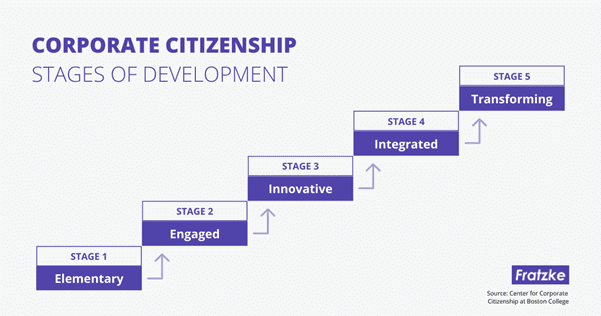
The Five Stages of Corporate Citizenship Development
For a company to be a good corporate citizen, it must have:
The capacity to give back to society
Credibility (often in the form of a desirable brand reputation)
The will to embed socially responsible practices into its culture and structure
A detailed understanding of community, cultural, and environmental needs
With an understanding of what corporate citizenship looks like, let’s now look at how a company might achieve it in practice.
1 – The Elementary Stage
In this initial stage, companies are primarily focused on compliance. Any CSR activities (if they exist at all) tend to be reactive, ad-hoc, and exist to avoid legal repercussions.
2 – The Engaged Stage
Companies in the second stage start to recognize the importance of engaging a variety of stakeholders. Basic CSR initiatives and policies are developed and the company sees them as more than just a compliance tool.
3 – The Innovative Stage
In the third stage, companies actively integrate CSR into their business strategy and operations. They appreciate the business case for corporate citizenship and see it as an opportunity for innovation and competitive advantage. Sustainability and social responsibility become drivers for new products, services, and even business models. Companies may also start to measure and report CSR-related performance.
4 – The Integrated Stage
As the name suggests, companies at the integrated stage have corporate citizenship embedded into their culture, strategy, and operations. Related practices and initiatives are communicated both internally and externally and aligned with broader business objectives. There is also a strong focus on shared value creation.
5 – The Transforming Stage
In the final stage, the company has become an industry leader and set new standards for corporate social responsibility. It may take on a leadership role in addressing global challenges and work to influence public policy, industry standards, and broader societal norms. Whatever the industry, such companies view themselves as the solution to major social and environmental issues and aim to create systemic change.
In the next section, we’ll conclude by detailing one company that has reached this transformative stage.
A Prime Example of Corporate Citizenship Efforts
Starbucks
Starbucks is perhaps the best example of corporate citizenship. Indeed, the worldwide chain pioneered the practice with one of its earliest commitments to only purchase ethically sourced coffee beans. In 2004, the company developed various Coffee and Farmer Equity (CAFE) practices in collaboration with Conservation International. The practices are now part of a program that sets standards for ethical sourcing, environmental leadership, economic accountability, and social responsibility. This ensures that beans are sourced and produced in a way that respects the needs of farmers, workers, and the environment.
Other Initiatives
In more recent years, Starbucks has introduced other corporate citizenship initiatives for a better future. These include:
Green power in stores – 100% of the company’s stores in Europe are powered by green electricity, and the company has committed to designing and building an additional 10,000 “Green Stores” by 2025.
Food waste programs – Starbucks is also an active participant in reducing food waste and supports the Action Against Hunger campaign. In the United States alone, the company has invested almost $73 million in hunger relief and diverted 69.4 million pounds of food from waste.
Equal opportunities – the company is well-known for its inclusive workplaces and employee support. As part of the Starbucks College Achievement Plan, Starbucks partners with Arizona State University (ASU) to offer free Bachelor’s degrees to employees. It also has a focus on recruiting military veterans and works with other organizations to help veterans transition back to civilian life.
In summary:
Corporate citizenship refers to a company's responsibilities towards society. This involves ethical behavior, sustainable practices, and contributions to economic development that also improve the quality of life for employees, the local community, and society.
Good corporate citizenship tends to be confined to larger companies with the capacity or financial means to contribute to society. Five distinct stages explain how a small business can transform into a visionary leader with fully integrated ESG principles.
Global coffee chain Starbucks is a prime example of corporate citizenship. Many of the company's initiatives were implemented well before the concept became fashionable or sought out by investors.